Did you know?
According to IWH standards, anchor points must be inspected and certified every 12 months to remain compliant.
Key Point:
Only professionals trained in anchor point installation and testing (IWH-recognised) can certify compliance.
Safe Access

Anchor Point Testing Johannesburg: Why It Matters

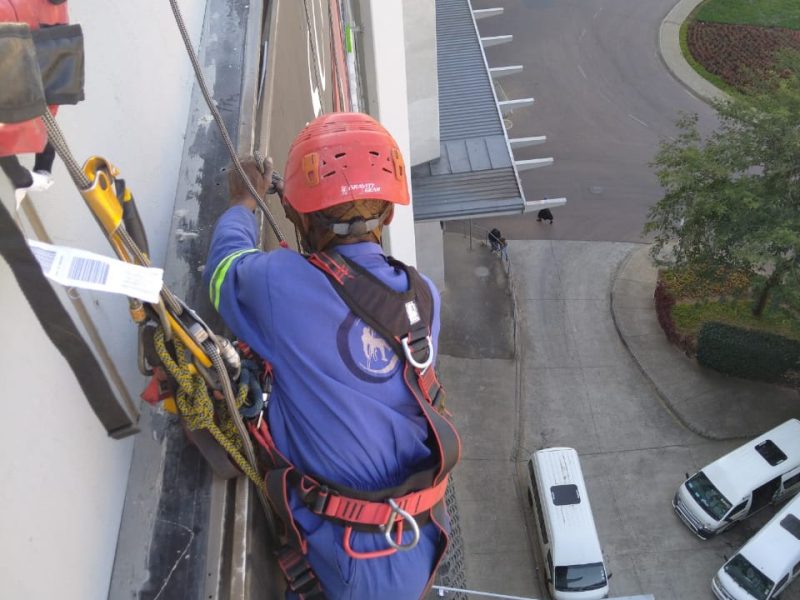
Anchor points are the foundation of every rope access job. Without certified anchors, no rope access team should legally be working on your building. This means that façade cleaning, signage repairs, and even inspections could all be taking place out of compliance if your anchor points aren’t tested and documented.

Safe Access

Rope Access Services in Johannesburg: A Smarter Way to Maintain High-Rises

High-rise maintenance in Johannesburg has always been a challenge. Traditional methods like scaffolding and cranes are slow to set up, disruptive for tenants, and extremely costly. Rope access services, however, are changing the game. By using certified technicians suspended from secure anchor points, tasks such as façade inspections, window cleaning, and signage repairs can be completed quickly, safely, and with far less disruption.

Safety First

Building Compliance South Africa: Regulations You Can’t Ignore

Resource IWH Good Practice Note explains that anchor point testing isn’t just a “best practice” it’s a compliance requirement under South African construction regulations. Testing includes load checks, shear/tensile force analysis, and proper embedment depth. Property owners who ignore this are leaving themselves open to liability, fines, and shutdowns if an accident occurs.

ABSA Tower Signage Repair - 360 Rope Access
Testing Protocols

Anchor Point Testing Requirements

See us in action

We provide anchor point testing and remediation, See our successful project: Rope Access Anchor Point Testing and Remedial Work – ABSA Bridge City

Safety

Rope Access Safety – Why Competence Is Key

One of the most overlooked risks is assuming “anyone” can sign off on anchor points. Resource SAIOSH highlights that even Rope Access Supervisors, engineers, or health and safety officers are not automatically competent unless they have anchor-specific training. This means many buildings in Johannesburg may already be operating on unsafe systems without realising it.

Safety Hazard

Hidden Technical Risks – The Eyenut Problem

Many Johannesburg buildings rely on M12 eyenuts, but SAIOSH explains that these only support 340kg axial load which is far short of the 600kg minimum required for fall arrest. Add in risks like cross-loading (where the ring isn’t aligned with the load direction), and what looks like a “safe” system can fail under stress. Worse, anchors installed into brick or precast blocks are completely unsuitable, even though they’re often used

Discover

Project Gallery

Risk Factors

Common Anchor Risks

Financial Risks

The Business Impact – Cost, Liability, and Delays

For property managers, the risk isn’t only technical — it’s financial. If an accident occurs on uncertified anchors, liability can fall directly on the property owner. Insurance claims may be rejected, tenants could demand compensation, and maintenance contracts may be delayed while compliance is restored. Anchor point testing is not a “nice-to-have”; it’s the first step in protecting your property investment.

Assurance

Compliance You Can Trust

At Rope Access 360, we don’t just test anchors, we ensure your building is legally and operationally ready for high-rise maintenance. By combining inspection, remedial work, and certification, we give property owners confidence that their anchor systems are safe, compliant, and future-proofed.

Property managers and compliance officers: Don’t wait until an audit or an accident exposes the risk. Book a Compliance Inspection with Rope Access 360.

Schedule an appointment with us

Don’t leave safety to guesswork, Book an Appointment with Rope Access 360

Ready to Protect Your Building?

 Protect your building, your tenants, and your reputation. Request a Quote for Compliance Testing Today.

Request A Quote